

Your design needs a spring to return a part to its starting position. The catalogue offers tension springs and torsion springs, and the names give you little to go on. Choose the wrong one and the part moves badly, wears early or needs redesigning around the spring. The quick answer is that a tension spring pulls in a straight line and a torsion spring turns around a point. The rest of this blog helps you decide between tension vs torsion springs for your own application.
Let the movement of your part decide
Before you look at sizes or materials, watch what the part does. If it slides or lifts away from a fixed point and has to come back, you need a pulling force, which means a tension spring. If it swings on a hinge or pivot and has to return, you need a turning force, which means a torsion spring. If it has to push, you want a compression spring.
That answer settles the type before anything else. Trampolines and lever return mechanisms use tension springs. Clipboards, door hinges, mousetraps, vehicle boot lids and throttle returns use torsion springs.
Tension in springs and how extension springs work
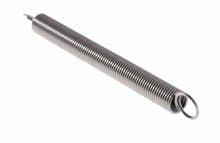
A tension spring (also called an extension spring) resists being stretched. Pull it and it pulls back, with a force that acts along its length. That is what people mean by tension in springs.
Close-wound tension springs also carry initial tension, a preload you have to overcome before the spring starts to extend. Include it in your force calculations, or a new spring will feel stiffer than your figures suggest.
Hooks, loops and screw-in ends carry the full load, so they deserve as much thought as the coil. We make tension springs on 18 coiling machines, from 0.1mm to 26mm wire, using hot and cold coiling. We produce close or loose- wound coils, with bespoke ends to suit your fixings. For very small assemblies, see our micro extension springs to find out more.
How torsion springs work and how to use them
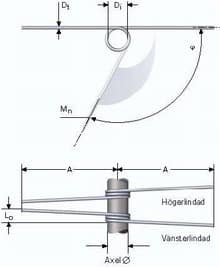
A torsion spring turns instead of stretching. Hold one leg still, rotate the other, and the coil pushes back with a torque that rises as the angle increases. Single torsion springs have one coil. Double torsion springs have two coils working together for higher torque.
Two habits that make fitting easier:
- Load the spring in the direction that tightens the coil. Twisting it the other way raises the stress in the wire.
- Support the coil on a rod or shaft slightly smaller than its inner diameter, because the coil shrinks as it winds.
We make torsion springs on 14 coiling machines, from 0.3mm to 26mm wire, and most leave the machine finished, with no secondary operations.
Where tension and torsion springs go wrong
Choosing the type is the easy part. These three problems appear later, and each has a clear fix.
Overlooking the ends. Springs usually break where the wire bends sharply, at the hooks of a tension spring and the legs of a torsion spring. Most buyers compare coils. We would compare ends first, and include the end design in your specification.
Working the spring to its limit. Every spring has a range of travel it handles comfortably. Stretch or twist beyond it and the spring takes a permanent set or fails early. Design so that normal use sits well inside that range, and leave the maximum for the unexpected.
Ignoring where the spring will work. Heat, damp and chemicals all attack springs. Steel and stainless steel cover most jobs. For harsher conditions we also work in alloys such as Inconel and beryllium copper. See our spring materials.
When a standard size will not fit
Many designs end up compromised to suit whatever spring is in stock. We would rather it worked the other way round. Our stock catalogue is the quickest route when a standard size fits. When it does not, we make your spring to order, starting from a drawing, an existing part or a description of the job.
Our team supports CAD design, prototyping, tool making and quality assurance, and you can read more about our approach to custom spring design. We are ISO 9001 certified, with more than 70 years of manufacturing experience, and we supply sectors including automotive, aerospace and medical.
Talk to us about your springs
Tell us what your part has to do and a member of our team will help you choose between a tension spring and a torsion spring, then make it. Contact us on 028 9600 9673 or request a quote with your drawing or a description of your application.
Frequently Asked Questions
Are tension and torsion springs the same?
No. Both are coiled wire that stores energy, but they work in different ways. A tension spring resists being pulled apart. A torsion spring resists being twisted. Each needs its own mounting, so you cannot swap one for the other without changing the part around it.
Which is safer if it breaks?
A broken tension spring can release its stored energy suddenly and come away from its fixings, so it often needs containing where people work nearby. A broken torsion spring usually stays on its shaft. Safety depends on the whole assembly, so assess the risk for your own design.
Which lasts longer, a tension spring or a torsion spring?
Neither, by default. Life depends on the stress in the wire, the material, the surface finish and how far the spring moves on each cycle. Our page on spring durability explains more.
What measurements do I need to order a spring?
For a tension spring, give the wire diameter, outer diameter, length with the spring at rest, end type and material. For a torsion spring, give the wire diameter, outer diameter, number of coils, leg length, leg angle and winding direction. Add the force or torque you need and the quantity. If you only have a sample or a drawing, send that and we will help you complete the specification.